Individual Income Tax Debt vs Company Tax Debt in South Africa
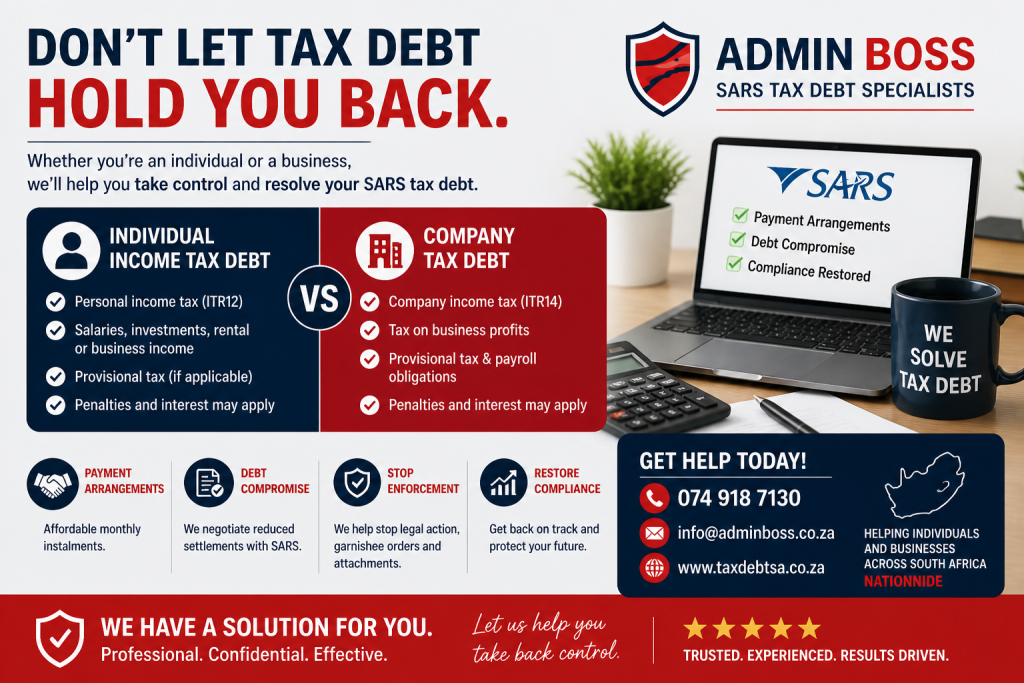
Tax debt in South Africa can arise for both individual taxpayers and companies, but the causes, obligations, and consequences can differ significantly. Individual income tax is charged on a person’s taxable income from sources such as salaries, business profits, investment income, and rental income.
Corporate income tax, on the other hand, applies to businesses such as private companies, public companies, close corporations, and other legal entities that earn taxable income during a financial year.
Understanding the differences between individual income tax debt and company tax debt is important because the compliance requirements, filing obligations, and debt recovery processes can vary. Admin Boss assists taxpayers across South Africa in resolving both types of SARS tax debt.
What Is Individual Income Tax?
Individual income tax is the tax paid by natural persons on their taxable income.
Income that may be subject to personal income tax includes:
- salaries and wages
- bonuses and employment benefits
- profits from business activities
- rental income
- investment income such as interest and dividends
- pension or annuity income
Tax returns for individuals are typically submitted annually using the ITR12 return, and the tax year runs from 1 March to the end of February.
Failure to submit returns or pay tax due can result in penalties, interest, and tax debt.
What Is Company Income Tax?
Company income tax applies to businesses that operate as legal entities.
Examples include:
- private companies (Pty Ltd)
- public companies
- close corporations
- non-profit companies
- co-operatives
These entities must submit an ITR14 corporate income tax return to SARS.
In addition to annual tax returns, companies are often required to submit provisional tax returns during the financial year based on estimated taxable income.
If these obligations are not met, the company may accumulate tax debt.
Individual Income Tax Debt vs Company Tax Debt
Although both individuals and companies may owe tax debt to SARS, the nature of the debt can differ.
| Feature | Individual Tax Debt | Company Tax Debt |
|---|---|---|
| Taxpayer | Natural person | Registered company |
| Tax return | ITR12 | ITR14 |
| Tax year | 1 March – 28 February | Financial year of the company |
| Income sources | Salary, investments, business income | Business profits |
| Additional obligations | Provisional tax (in some cases) | Provisional tax and payroll taxes |
Both types of tax debt may trigger SARS enforcement actions if the debt is not resolved.
Causes of Individual Tax Debt
Individual taxpayers may accumulate tax debt due to:
- failing to submit annual tax returns
- incorrect tax declarations
- insufficient PAYE deductions
- provisional tax underpayments
- penalties and interest
Individuals who earn income from multiple sources may also find that PAYE deductions are insufficient to cover their final tax liability.
Causes of Company Tax Debt
Businesses often accumulate tax debt because of compliance or cash-flow issues.
Common causes include:
- unpaid corporate income tax
- unpaid VAT
- PAYE payroll liabilities
- late submission of tax returns
- penalties and interest
Companies must ensure their business details remain updated with SARS and that returns are submitted electronically through eFiling.
SARS Enforcement for Tax Debt
When tax debt remains unpaid, SARS may initiate enforcement procedures.
These may include:
- issuing final demand notices
- applying third-party appointments
- attaching bank accounts or salaries
- civil judgment proceedings
Both individuals and companies can face these enforcement actions if the debt is not resolved.
How to Resolve Individual or Company Tax Debt
Several options may be available depending on the taxpayer’s circumstances.
Payment Arrangement
A payment arrangement allows taxpayers to repay tax debt in instalments over time.
Tax Debt Compromise
In certain cases, SARS may accept a reduced settlement amount if full recovery is unlikely.
Disputes or Objections
If a tax assessment is incorrect, taxpayers may dispute the assessment through SARS procedures.
Taking action early can prevent further enforcement steps.
How Admin Boss Can Help
Admin Boss assists individuals and businesses across South Africa with resolving SARS tax debt.
Services include:
- reviewing SARS statements of account
- responding to final demand notices
- preparing payment arrangement applications
- assisting with tax debt compromise submissions
- restoring tax compliance
All services are provided remotely across South Africa.
Get Help Resolving SARS Tax Debt
If you are dealing with individual income tax debt or company tax debt, early action can help prevent enforcement measures and restore compliance.
FAQ
Can both individuals and companies owe tax debt to SARS?
Yes. Both natural persons and registered companies may accumulate tax debt if taxes are not paid or returns are not submitted.
Do companies pay tax the same way as individuals?
No. Companies submit ITR14 corporate tax returns, while individuals submit ITR12 personal tax returns.
Can tax debt lead to enforcement action?
Yes. SARS may recover outstanding tax debt through legal enforcement measures if the debt is ignored.
Can businesses apply for payment arrangements?
Yes. Both individuals and companies may request payment arrangements depending on their financial position.